Assistant prof. Matevž Rašković, PhD: ”China is putting money where their mouth is”
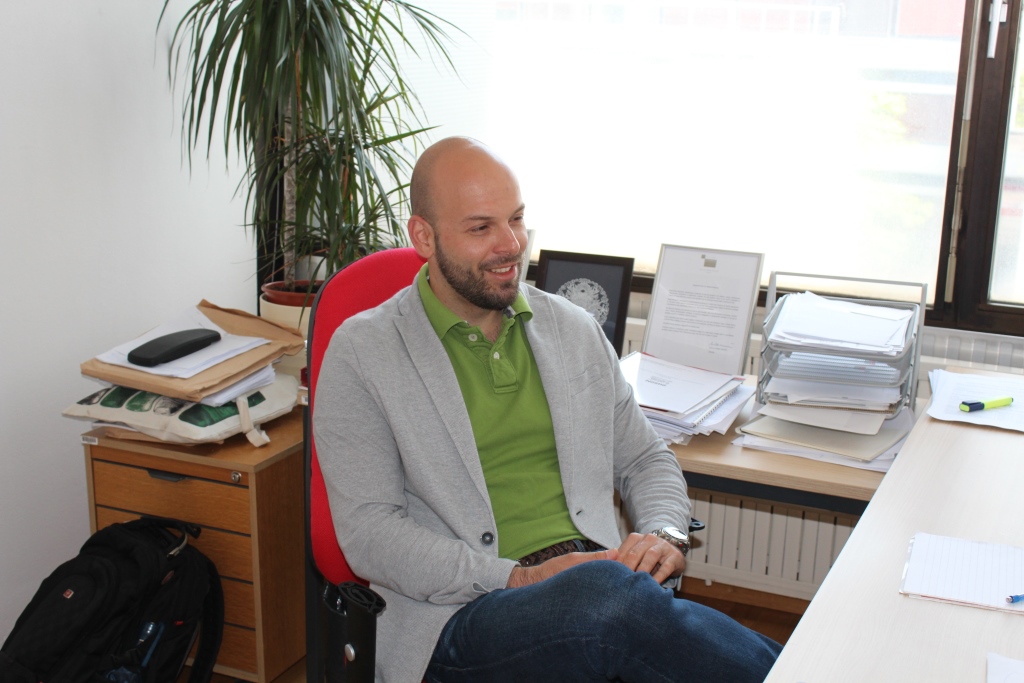
If you are looking for an expert, who knows something about how business works in China, Matevž Rašković is definitely the man for the job. The recipient of numerous awards, he is an assistant professor of international business at the Faculty of Economics and the new acting head of the Masters of International Business English track programme. EFnews was very pleased to interview him. Despite his busy schedule, he was able to answer a few questions regarding the unique field he specializes in – Business with China.
Why did you decide to specialize on China?
When I came back to the school from the U.S. during my PhD, I was told about our school getting a Confucius institute by Mrs. Danijela Voljč, head of international office. Nobody at that time knew a lot about China and she kindly asked me, if I would be willing to help set up a course on How to do business with China, since my background was international business. Back then, I had no experience related to China and frankly, I had never even been to China. Throughout the first year, I somehow managed to survive by involving many guests from the business world, but I was always afraid of a student asking me: “When were you in China?” Therefore, when the course finished, I went straight to our international office and insisted on being given the opportunity to go to China and build my expertise. I have been going to China ever since, in order to fully understand one of the most complex countries in the world. The longest I stayed in China was 4 months in Shanghai, as a visiting scholar at our partner – the Shanghai University of International Business & Economics (SUIBE).
Are we here talking about their culture, language or business?
Everything. I am also telling my students that mastering the Chinese language for example, is not a necessity for doing business in China. Of course, it helps if you know the language, but the key is to be culturally sensitive and flexible. Here we are talking about understanding their mindset, how they think and how they look at things, what’s important to them, their cultural background etc. Language can help you, but it is so complex that it is not worth spending all your time and energy in trying to master Chinese and speak it perfectly. As a business person, it is better to develop other types of skills and use interpreters when you really need them.
We are all familiar with the term “The world has become a global village“. How does this affect companies and their decisions, regarding what and where they are going to be manufacturing their products?
Globalization is an interesting thing. In some ways, the world has become increasingly flat, but in other ways, it has by far not flattened at all. Theodore Levitt published in 1983 in Harvard Business Review a paper entitled “Globalization of markets”. He stated that in 20 years’ time, everybody is going to be exactly the same and the world will converge in the face of globalization – there will be no cultural differences, everything will be standardized. What we are seeing down the road today is that we are surprisingly similar in certain things, but becoming increasingly different in other ways, so Levitt was only partly right. I would say that we are here actually talking about “glocalisation”. This is a sort of hybrid between globalization and local uniqueness shaping the environment where universality and contingency co-exist. For example, 10 years ago everybody went to China to produce, because it was cheap. China was seen as the factory of the world. Similar to Apple, for example, they were creating and designing in the U.S., but their products were produced in China. After a while, they realized that they were losing a lot of knowledge and innovation-building capacity, so therefore they retreated from the Chinese market and started producing more locally. Now, China is viewed more as the key market of the world to sell your product.
So is this the main reason for enormous Chinese growth we know today?
In 18th century, Napoleon said: “China is a sleeping beauty. Let her sleep, for when she will wake, she will astonish the world”. By 1840, China represented almost 35% of the global GDP. So historically speaking, China was, because of its size and population, already the number one global economy. One could thus say that Chinese growing economic power is just history repeating itself. When China opened up again in 1978 under Deng Xiaoping, it was a really poor and underdeveloped country. It had hundreds of millions workers that were willing to work for almost nothing. If we look over this 35 years period, Chinese growth has been absolutely astonishing, but in the past years, it has started slowing down. There are many reasons why this is the case, but in my opinion, that is a good thing, because China realized that it needs to have more stable and inclusive growth. Today, China is changing its economic model and the lower growth under the so called “new normal slogan” is based on more prudent set of socio-economic priorities.
One of the consequences of its growth is also pollution. Is there still a chance for China to fix this problem?
I think that a lot of the damage that has been done can still be reversed, but time is running out. Out of some 700 million people living in urban China, only 1% are breathing air that meets minimum standards of quality by the World Health Organization. The biggest problem here is China’s current energy model, since 70% of energy comes from coal and 85% from coal and other fossil fuels. Air pollution is a problem, but so is water pollution, mainly because of its shortages. They get most of the water from Tibet and because of the global warming, this resource is getting depleted. This can have devastating effect for close to 2 billion people living in East Asia, particularly China and India. The West needs to realize that it needs to become a more constructive partner and assume its share of the responsibility as well. For example, it is very easy to be an American company, planting green grass on the roof, saying that we are an environmentally friendly company and then you have all your factories in China where you do not care about environmental standards. So without a doubt, China is a huge polluter, but about half of this pollution is actually linked directly in indirectly to foreign direct investment in China. The West has become developed by exploiting other countries and their environments for centuries. Of course, this does not mean China can do the same and pollute, but it always takes two to tango. We, as consumers, also need to realize that we can vote with our wallets. How do they plan to reduce the pollution level?
Now China is strongly focusing on renewable sources. If we are talking about wind energy, for example, China is currently the number one market in the world in terms of producing energy from the wind. They are also investing a lot into hydro, solar and geothermal energy. They are really putting their money where their mouth is. For instance, they invested $300 billion just in wind energy. They’ve also set a target that by 2020 they want to have 5 million electric cars on the roads and on top of all that, their government has said that from the next year on, one third of cars purchased by the government have to be electronic. I think that China will actually be leading this sort of “green revolution” and that 2016-2020 period corresponding to the 13th 5-year plan will be sort of a key period. The fact that China’s economic growth is slowing down is actually a good indicator, because there will be less pressure on energy and the environment.
Lastly, in this year’s annual speech to the Chinese people, Chinese premier Li Keqiang outlined some of the other priorities besides the environment which will drive China in the next 5 years. The key message to be taken from his speech was “human capital”. In particular, China will invest a lot in education and healthcare to build this human capital base. Investment in education will become the biggest government expenditure, bigger than defense. This will create a lot of opportunity also for foreign students wishing to study in China, as well as Chinese students wishing to go abroad. Combining this with China already investing 2.2% of GDP in R&D, which is higher than the EU-28 average, we will need to start thinking of China as an innovative nation pretty soon, not as the factory of the world. I can envision a future, maybe 10 years down the road, when products might be designed in China and manufactured in Poland, Romania, or even Slovenia.
Matej Jerele, EFnews

Image gallery:
Related news
Publish your comment:
 Upcoming events


