Centre of Excellence for Biosensors, Instrumentation and Process Control COBIK bridges the gap between science and industry
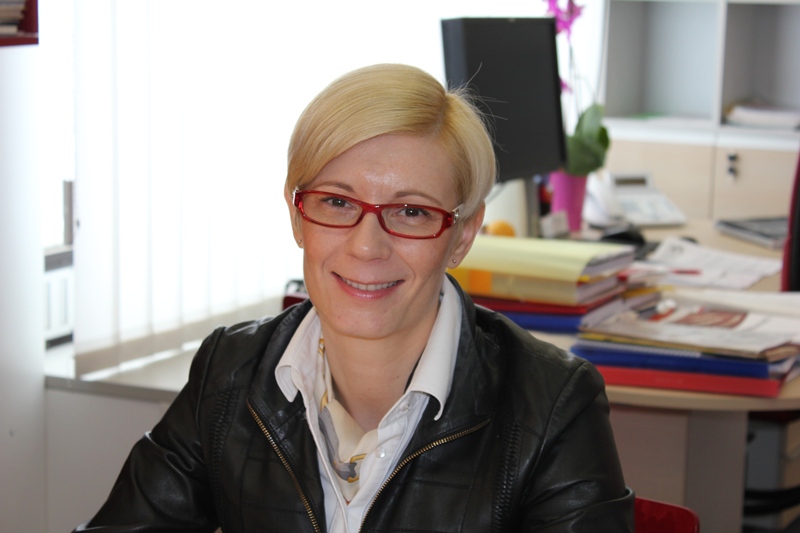
The director of COBIK, Mrs. Rebeka Koncilja, devoted her Friday afternoon entirely to EF News and presented the work done by COBIK and its relationship to the Faculty of Economics which before this hasn’t been known to us. The Faculty of Economics is a co-founder of COBIK and a leading partner in the Laboratory for Open Inovation Systems (LOIS). Rebeka Koncilja also comes from the Faculty of Economics: She was once a student there, and later on also a demonstrator at the faculty and Prof. Dr. Janez Prašnikar’s colleague when he was the vice dean of research. Currently, she is the Head of the Research Unit. In her pleasant, neatly-organized office, she gave us comprehensive answers to all our questions, and thus broadened our horizon.
1. The work done by COBIK is getting wider and deeper. What does this mean for economists and where can they find the connection and added value?
Our centre is extremely interdisciplinary as we work in various fields, from biosensors, instrumentation, advanced materials and control systems to bio-analysis. And the idea was to link these research pillars with the horizontal laboratory for open innovation systems, which could provide all the research contents verticals with appropriate business skills for faster commercialisation of the new knowledge, new technologies, services and products which are being created within the centre and could be commercialised in newly-established companies.
 Since it was established, the Laboratory for Open Innovation Systems has been used as a some sort of link between science and industry.
The partners invited EF to participate in this project because they believe the »economists« would help create the missing link which would establish functional models of cooperation between the key figures which provide high-tech marketing successes.
In these three years, the Centre of Excellence created an effective system of innovation transfer, intellectual property management, and systematic and focused training for developers, entrepreneurs and researchers. LOIS, with EF being its key partner, made a great contribution to this.
2. The COBIK conferences take place at the Faculty of Economics. What is the main reason for this?
»The Laboratory for Open Innovation Systems, where EF plays a very important role, is the main organiser of COBIK conferences. The head of the project is Prof. Dr. Maja Makovec Brenčič. The EF was selected as the location for these conferences based on thorough consideration. We Partners were aware that it would be easier to organise this event at the beginning in Ljubljana, at the EF, from the point of view of the public as well as the speakers. Moreover, the EF has all the necessary infrastructure for such events, and on the conference, we also work together with the EF Centre for Business Excellence.”
3. Which in your opinion is COBIK’s greatest accomplishment and why?
I would highlight more accomplishments, especially because they cannot be compared to one another. The main goals set by the centre were connected with the development of new technologies, products and services, and our purpose was to conduct research in connection with industrial prototypes, which is followed by commercialisation, however, not within the centre – we are requested to transfer this new knowledge to the excluded companies or the founders. These then focus on commercialisation. Up until now we have created 49 amazing innovations, 59 prototypes, filed 2 patent applications, in 2012 we established our first spin-off company in the field of bio-analysis. At the same time, our researchers made over 150 scientific publications, SSCI publications as well as other publications based on the ARRS criteria.
 I would especially like to highlight the following article, which is based on the work done by LOIS: Černe, M., Nerstad, C., Dysvik, A., & Škerlavaj, M. (Forthcoming). What goes around comes around: Knowledge hiding, perceived motivational climate, and creativity. Academy of Management Journal.«
4. encourages and motivates you to transfer knowledge and good practices?
Fast transfer of knowledge is a key factor for success on the market. Our industrial partners are well aware of this.
5. In your opinion, which was the decisive factor which gathered the researchers, institutions and companies in one place.
Definitely awareness that for great breakthroughs there is still a lot of room for improvement from the technical, scientific as well as marketing point of view. Our industrial partners, who invited the EF to participate and who all have an amazing track record of participating with world renowned research institutions, and are therefore experts when it comes to entering into such cooperation, have seen the opportunity in bridging the gap between industry and science. Intensive cooperation in the new fields was really promising, and I am glad that this trust in one another and in our fund providers was justified.
6. How can COBIK in your opinion contribute to Slovene economy.
»The transfer of new knowledge into industry, new companies, the education of new, young future employees who became acquainted with the new fields of research in COBIK and evolved into researchers, who also know how to participate in research and industry processes – this is what I wanted to highlight before I continue!
Within the Centre, through new approaches in leadership and knowledge management, we together with our partners from economy participate in the development of new technologies and through our knowledge contribute to their development and to the upgrading of the existing ones. Apart from this, we contribute by collaborating with other centres of excellence, competence centres and research centres. Within the project Co-invest, which is also a project carried out by LOIS, we train scientists for academic entrepreneurship, which is already showing first results through the formation of spin-offs.”
 7. What are COBIK’s goals for the future, and do you already have international goals/strategies?
“In the last three years, our Centre of Excellence managed to raise the level of scientific and research contacts from the level of researcher-researcher to the level of institution-institution, and thus achieved spill-over effects within certain institutions in Slovenia as well as among the partners participating in the project. We signed 10 cooperation agreements with research institutions and companies in Europe, Russia, Kazakhstan, the USA, India and China. We are also preparing to sign cooperation agreements with Brazil. The signed agreements are already showing the results such as contracts between companies in Slovenia and abroad, with our Centre of Excellence participating in the implementation process. With regard to internationalisation, cooperation with multinationals has a special role. Within this cooperation we see the opportunity to promote Slovene knowledge and to make the best of business opportunities and potentials.
For the time period up to 2013, we set in our vision a very ambitious goal “to become an internationally renowned centre of excellence, which constantly grows through the activities of the open innovation system. We plan to form at least three spin-offs and at least 10 patents. We will attract the best human resources and partners, and become recognised as the cradle of new technological solutions in the fields of biosensors, instrumentation and process control.” Our activity, however, doesn’t end in 2013 since we strive for long-term existence and constant development by implementing our long-term mission. This is why we also have a long-term vision for after the year 2013: to become an independent European organisation with open, innovative business culture, which will prove its success through the increasing financial and professional power which will be focused on risk research, attracting and constant training of the best human resources and creating the increasing number of globally recognised technological solutions and spin-offs. At least 50 % of research funds should come from Europe or abroad.
The main short-term operative goal of the centre is to assure stable funding after the year 2013.”
Ajda Gavrilov, EFnews
Translated by Živa Furlan

Image gallery:


Related news
Publish your comment:
 Upcoming events


