Interview: Hilde Blomme
“Improving the quality of accounting and auditing standards will however bring their contribution to trying to avoid a crisis of this magnitude in the future.”
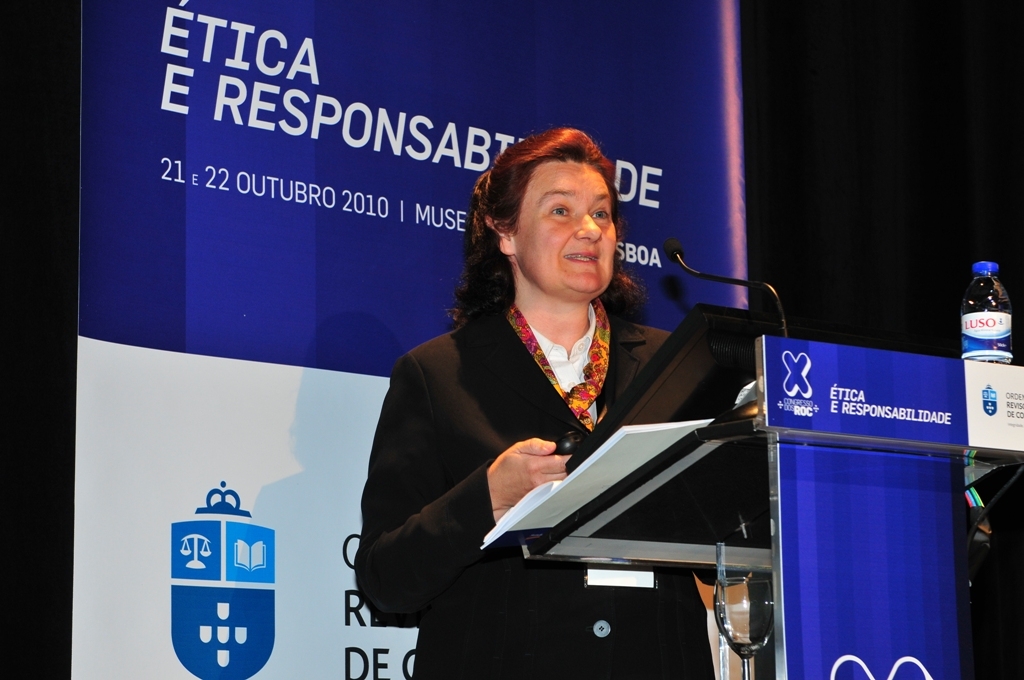
Hilde Blomme is the Deputy Chief Executive of the FEE (European Federation of Accountants). She also took part in the annual congress of the European Accounting Association held in Slovenia by the Faculty of Economics.
1. You work closely with the EU. What would you say the main problems are that the EU is facing now in general? And specifically in your area of expertise?
As you will be aware, the European Union is composed of 27 Member States representing sometimes very different national, economic, legal, cultural, historical … backgrounds. In general terms, the rules of the game are that the European Commission proposes legislation, rules, guidance, etc and the European Parliament together with the Council of Ministers of European Member States has decision power. Such processes often take time and might result in actions being ‘the best possible compromise’, sometimes perceived as being: ‘too little too late’. In addition to the current climate, Member States (but perhaps everybody) seem unfortunately less inclined to compromises and to advancing Europe as a whole. It may be complex but it is more transparent and maybe even more democratic than many think or say it is.
Additionally, in the areas of expertise of the FEE, we often consider our role is to inform the political debate as our counterparties from the European institutions are often not technical experts in our areas and are often only spending a number of years on a specific subject matter.
2. Will the crisis transform EU stance on auditing standards? How will this effect particular member state and its sovereignty? Are you personally in favor of tighter union that is of federalism or do you think countries can continue on as it is?
Whether one believes in federalism or in national sovereignty is a matter of political opinion. What appears more clearly in today’s world and economy is thatEuropeitself may be a small player.
We are very hopeful that the EC proposals to adopt the International Standards on Auditing (ISAs) as issued by the International Assurance and Auditing Standards Board (IAASB) adopted for use for all statutory audits in the European Union will be accepted by the European Parliament and Council. These international standards are already widely accepted in over 100 countries worldwide and are based on current best practice to achieve a high quality audit. We believe they respond to a number of concerns which were expressed following the financial and subsequent economic crisis, like for instance lack of use of professional skepticism, audits of groups, etc.
FEE believes that clear, understandable auditing standards, capable of consistent application would help simplification and reduction of administrative burdens as lots of companies and thus audits are currently performed cross-border. This is not only true for auditing standards but also for other matters related to auditing. This might affect the (perceived) sovereignty of EU Member States but this disadvantage might be outweighed, especially in smaller countries likeSlovenia, by avoiding having to invest in developing national auditing standards and national auditing legislation.
It should however be noted that most European legislation in the area of auditing, have until now been Directives, which set a minimum level of harmonization for all EU Member States, to which they can add if they so wish.
The European Commission proposal of 30 November 2011 in relation to the statutory audit of public interest entities is a regulation which, if adopted, would become automatically applicable in all EU Member States without any further national legal intervention. The proposals made are very far reaching and would have very serious consequences for our profession; we would even dare to say they are overregulation.
4. Is so called integrated reporting a response to the crisis, where many investors lost their trust in companies?
FEE is interested in the work which is being done on integrated reporting and has established a dedicated group within its organization to look at it. We have for instance commented on last year’s Discussion Paper of the International Integrated Reporting Council (IIRC) on integrated reporting.
FEE has also looked at the facts and circumstances related to the integrated reporting because we learned in our deliberations, that it might not be clear to many what integrated reporting is supposed to be about and what impact it might have.
We would generally agree with the comments of many that financial and non-financial reporting by companies, or corporate reporting at large, is at a stage which justifies looking at it again. Especially financial reporting is often criticized for including too much ‘clutter’ at the risk of losing focus on the information of real importance. Therefore, integrated reporting is worth looking at and might be a response to some of the criticism being made about corporate reporting, but to refer to it as the matter which will re-instill trust in companies might be too ambitious for now. Conversely looking at it as a response to the crisis may be too narrow as it takes a broader perspective.
5. Could ENRON happen in Europe? How to insure the aftermath of that ordeal doesn’t happen again and that auditors and accountants do their job well? Are there mechanisms to ensure that? Or is it all based on blind trust?
Although we would all like to hope for it, corporate failures cannot be 100% eradicated, and the same is most probably true for audit failures.
The collapse of Enron is often considered as a combination of many factors, an application of accounting principles and rules failure, a lack of exercising professional skepticism, an excess of the provision of non-audit services by the auditor, etc. without necessarily any of these being unlawful at that time. Over the last ten years, all of these and many other issues have been addressed. A FEE background paper on ‘Improving the quality of audit: building on 10 years of lessons learnt’ outlines the actions taken by the accountancy profession to innovate auditing practices and to improve the quality of audits in the last 10 years.
This background paper demonstrates that the professions, together with regulators, legislators and other stakeholders have contributed significantly over the last ten years to set up mechanism to make sure that auditors and accountants, both inside and outside of the companies, do their jobs well.
Blind trust is clearly not enough.
6. IIRC (International Integrated Reporting Comittee). How successful it really is? As we know it was brought to the G20 meeting in 2011. Were you successful in “selling” your proposal to the G20 countries? Have you encountered any obstacles?
IIRC’s is attempting to be innovative and reshape corporate reporting in order to make it more useful and informative to users. The IIRC has just started on this and it appears to get support for their initiatives. The pilot project in which many corporations are engaged is particularly interesting and shows the interest of business leaders. The IIRC is not an invention of accountants, it responds to a demand from stakeholders and a need of today’s transforming economy. A lot of work is yet to be done as we are at the beginning of integrated reporting and much more would need to be developed before it can be used in a more widespread way, for instance a framework or benchmark on how a company can prepare an integrated report would be very useful to have.
However, integrated reporting is already being used in practice andSouth Africais the first country which has adopted integrated reporting already now.
7. I took special interest in your (FEE) work with financial derivatives. How far did the “Banks working party” come with the development of International reporting standards?
FEE’s work in this area is primarily focused on responding to Exposure Drafts of the International Accounting Standard Board (IASB) and to Exposure Drafts of the European Financial Reporting Advisory Group (EFRAG). The work FEE accomplishes, for the moment does not encompass surveys, field testing, consideration of case studies, etc.
We are obviously also dialoguing with the European Banking Federation (EBF) in respect of these issues.
8. Can proper audit and account standards deter next financial crisis or at least the crisis in such proportions like the last one?
Can proper medical standards prevent the next pandemics? It should be pointed out that the last financial crisis appear to have been triggered by a lot of interconnected factors, including a liquidity crisis in financial markets, fuelled by issues in the US real estate market, which resulted in a snowball effect on financial institutions and later the economy as a whole. The financial crisis is definitely not an accounting standards and auditing standards issue. It was a much deeper, much more complex and much wider issue involving not only accounting, financial reporting and auditing but also corporate governance, regulation and supervision of financial markets, etc. (not to mention monetary policy and political decisions). Improving the quality of accounting and auditing standards will however bring their contribution to trying to avoid a crisis of this magnitude in the future.
9. I know your stay in our country is short, but still, what’s your impression about Slovenia and about our School?
It made a great impression on me. I came to Slovenia and Ljubljana for the first time in 1991 and I have been back since a few times. I liked the Faculty of Economics a lot as it appears not only open-spaced but also open-minded. Everybody seems to speak really good English, which was very helpful to me to get around.
Kristian Jerebič, EF news
Image gallery:
Publish your comment:
 Upcoming events


