The new face of the Euro – Discussion on the current state and the future of the Euro area

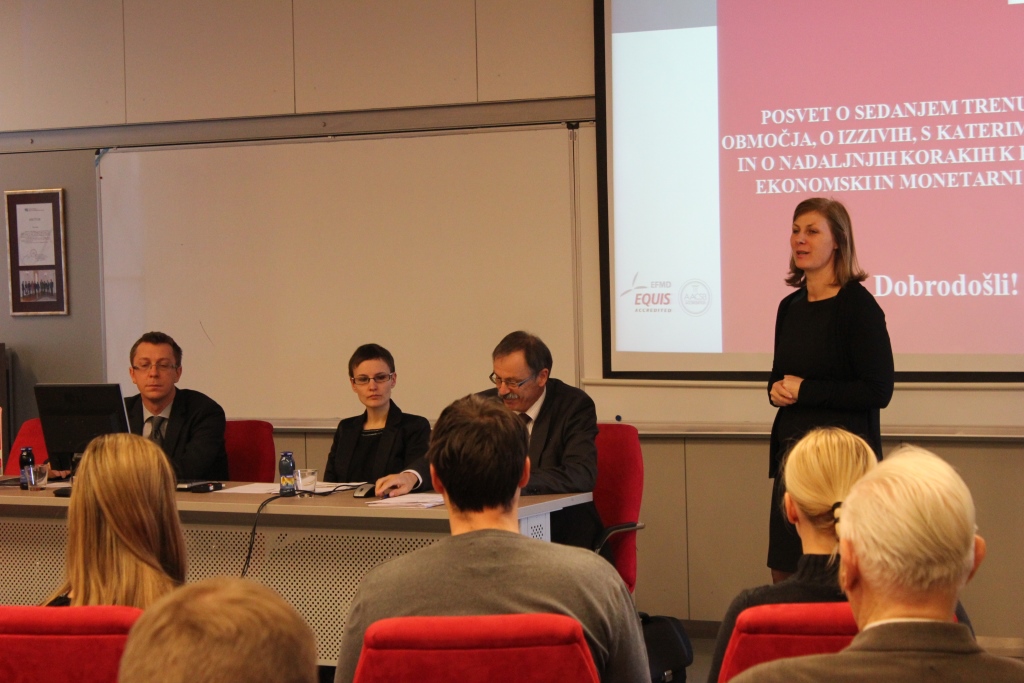
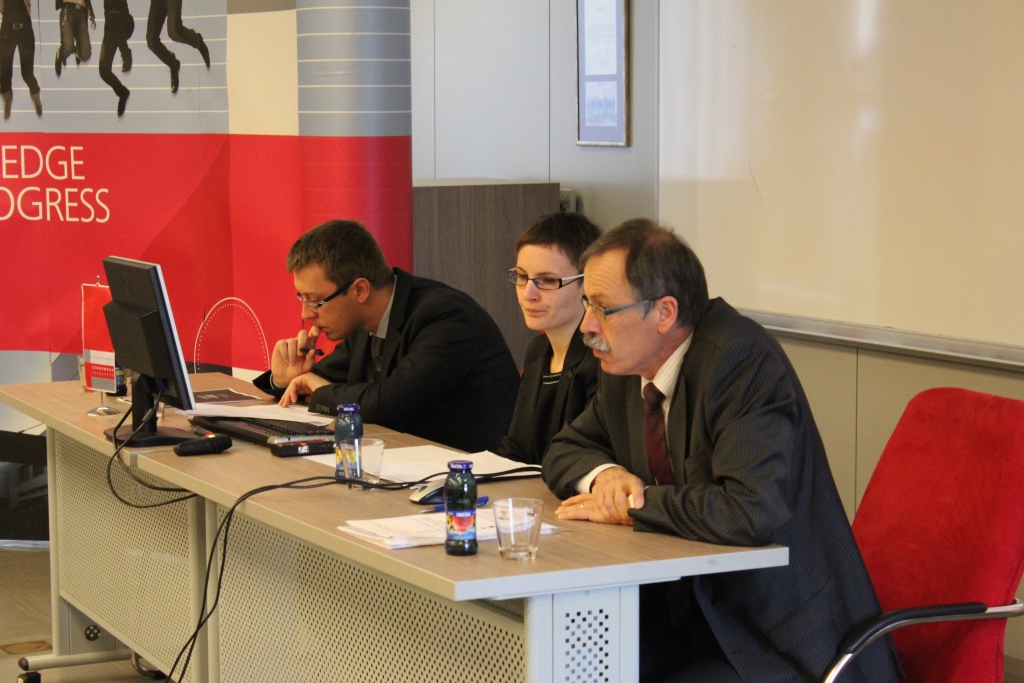
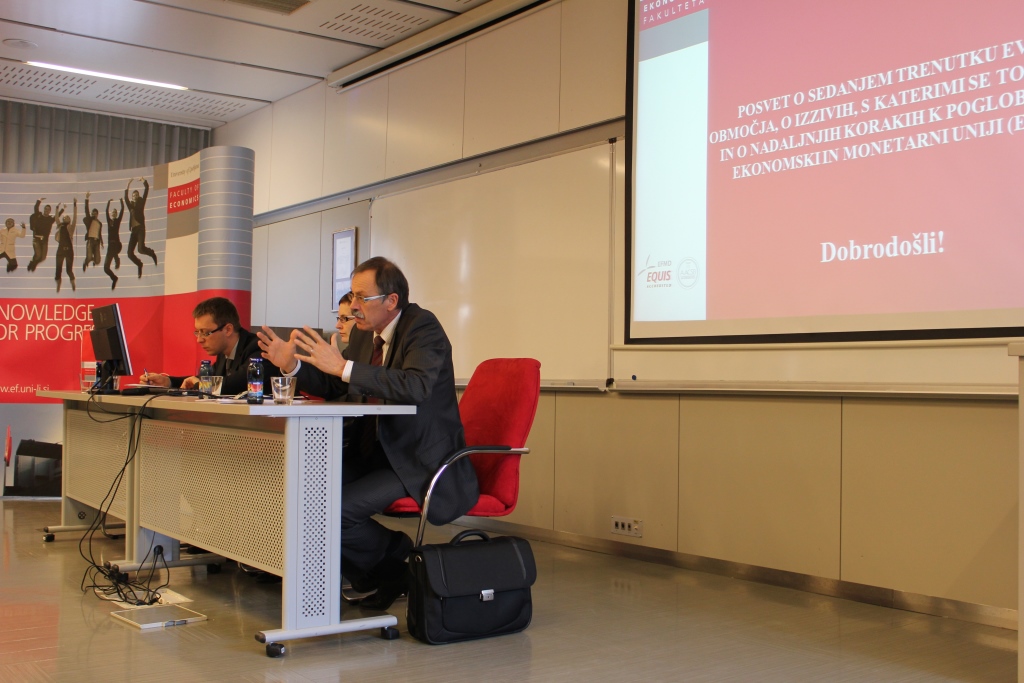
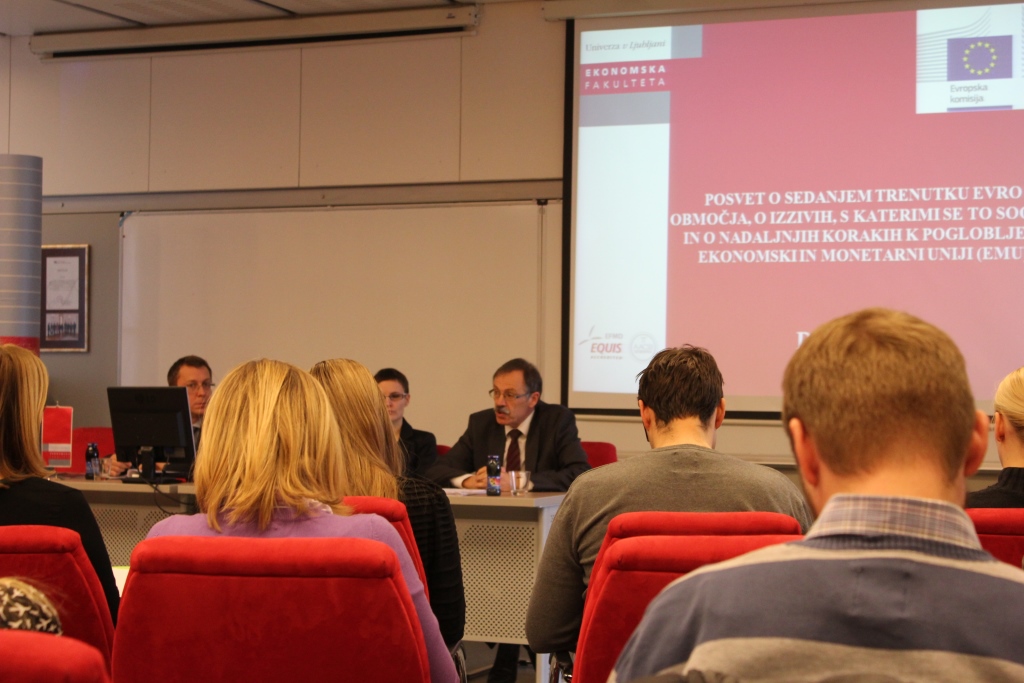
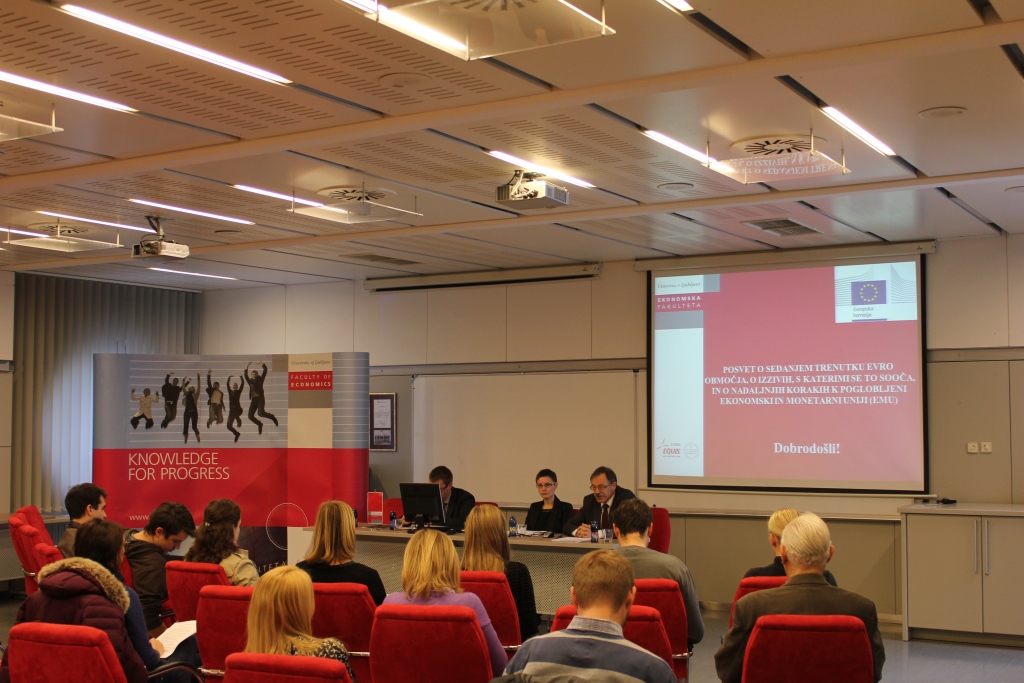
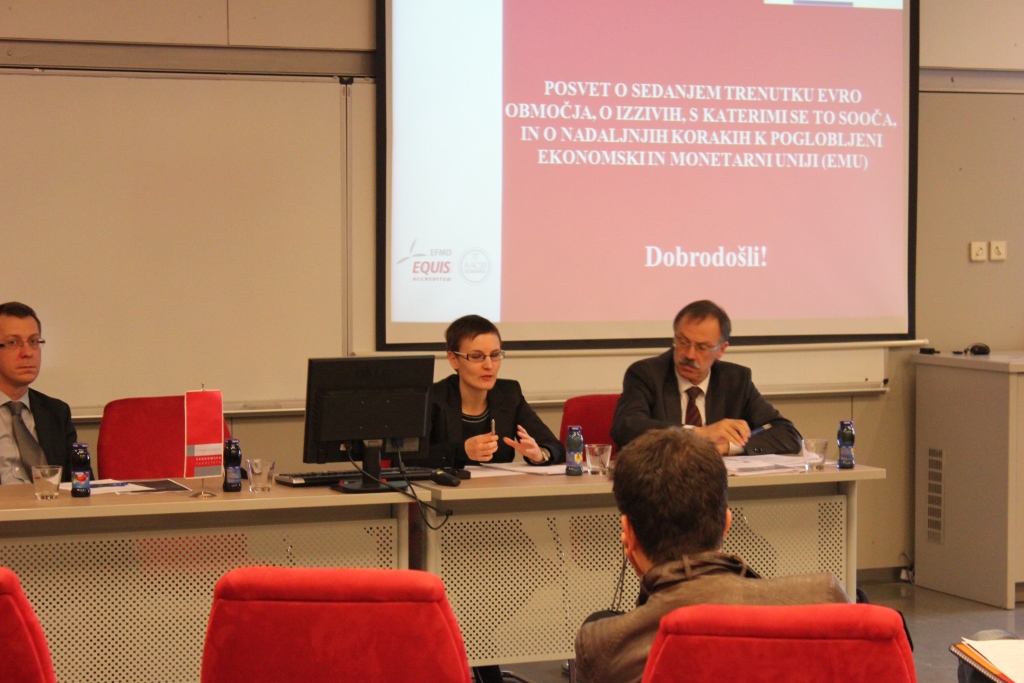
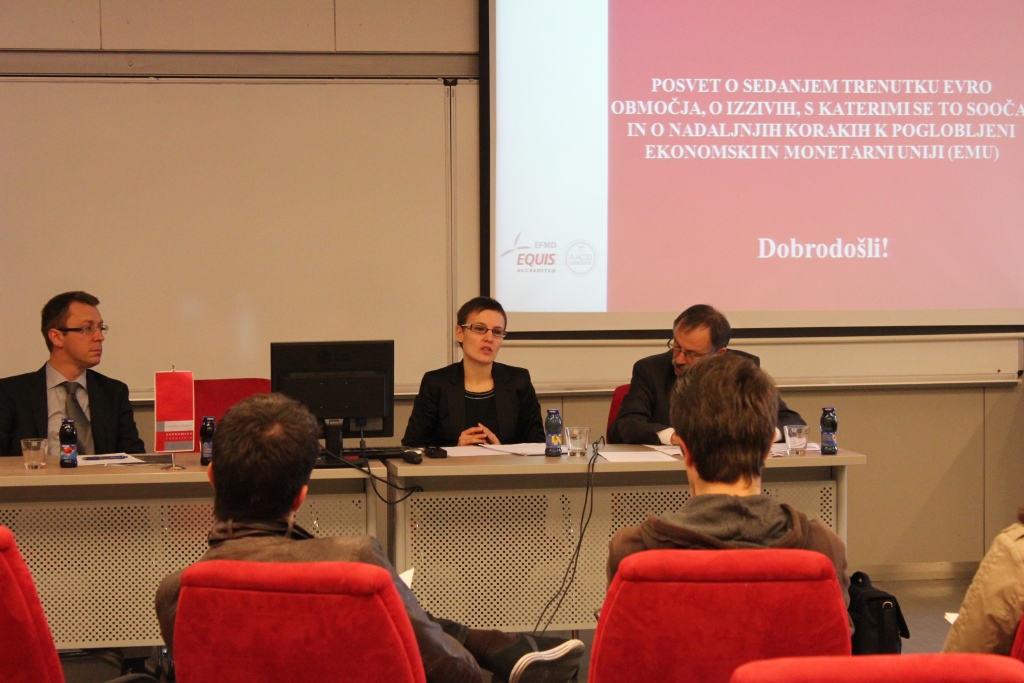
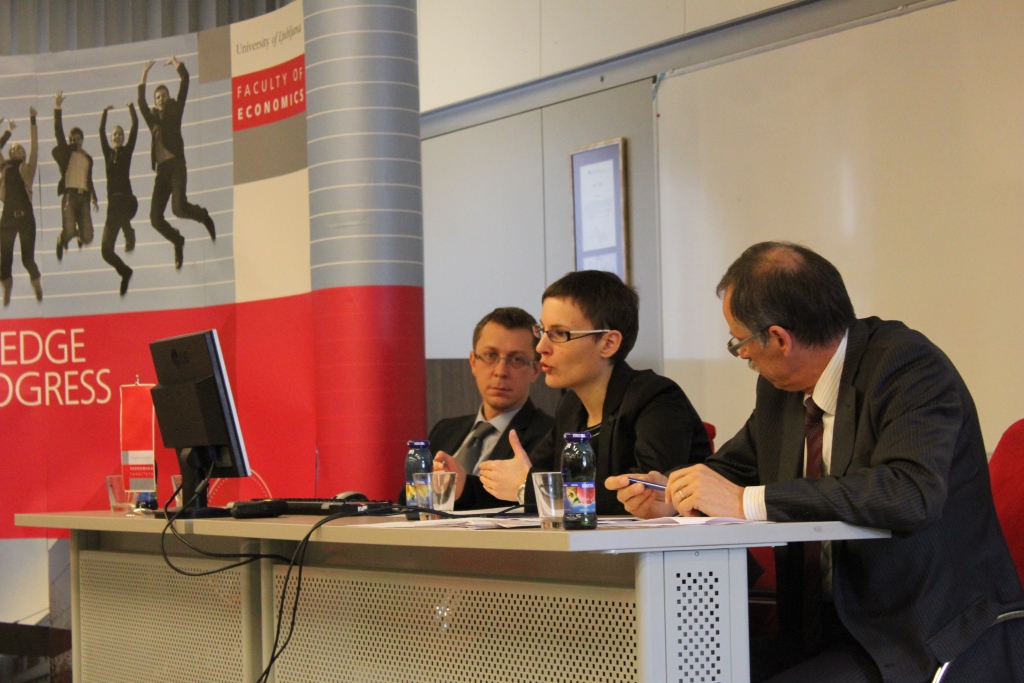
ON Thursday, 19.3.2015 the Jean Monnet Chair at the Faculty of Economics and the European Commission Representation in Slovenia held a discussion on the Current Situation of the Euro Area, the Challenges it Faces, and Further Steps Towards Deeper Economic and Monetary Union (EMU). The debate was motivated by statements made by European Commission President Jean-Claude Junker, President of the European Council, Donald Tusk, President of the Euro group Jeroen Dijsselbloem and President of the European Central Bank (ECB), Mario Draghi in their “Analytical Note” titled: “Preparing for Next Steps on Better Economic Governance in the Euro Area”. Introductory presentations were given by prof. dr. Mojmir Mrak, Jean Monnet Chair Professor at the Faculty of Economics and Katja Novak, from the Ministry of Finance of the Republic of Slovenia.
Member states tired, but hardened by crisis.
During the introduction, Professor Mrak discussed the origins of the institutional failures of European economic governance. Before the crisis, the system was characterised by a weak crisis prevention mechanism and the total absence of a crisis resolution mechanism. The crisis has caused significant changes in European economic governance. Today, EMU and EU governance is much more complex than before the crisis. In contrast to the pre-crisis Pact for Stability and Growth, which was narrowly focused on fiscal issues, the revised European economic governance covers many other issues, including macroeconomics, imbalances, competitiveness, banking union… Within this context, prof. Mrak emphasized: “For solving the crisis on a long-term basis, we will have to address the fiscal leg of the monetary union more seriously. We should start a discussion about a euro area fiscal capacity and we should strive for putting in place a mechanism that will combine structural reforms with limited and temporary fiscal transfers to Member States which find themselves affected by an asymmetric shock. The economic situation in the European Union has been improving in recent months, but on the other hand, the Member States are tired of the crisis and lost appetite for further reforms”.
In May, the European Commission will present a concrete program for strengthening European economic governance with medium-term objectives, as well as with long-term goals, which should, according to prof. Mrak, include also steps towards a fiscal capacity of the euro area, with the possibility to put in place a proper euro area budget and euro area borrowing capacity.
Slovenia was the first country to climb the stability ladder
Ms. Katja Novak from the Ministry of Finance presented the details of the reforms of the Pact for Stability and Growth introduced through so-called “six pack”, “two pack” and “Fiscal Compact” measures. She explained that countries where the public finance deficit exceeds 3 % of GDP are put under the excessive budgetary pressure and have to commit themselves to reduce the deficit over a determined period of time. Similar surveillance procedures are also being applied for excessive macroeconomic imbalances. Slovenia was under both procedures in recent years, but has recently succeeded, as the first case of this kind, to improve its status on the macroeconomic imbalances ladder. For 2015, Slovenia also adopted a budget that will bring its public finance deficit to a level below the 3% of GDP.
How to proceed?
In the debate, various issues of European economic governance were discussed, including some of the most recent ones, such as the street riots in Frankfurt last Wednesday on the occasion of the opening of the new ECB headquarters. Protests that unfortunately turned violent were focused on the highly restrictive fiscal consolidation policy that protests believe prevents a return to a sustainable economic growth.
Participants of the discussion also commented on changes that the new European Commission and its President Jean Claude Junker introduced in its approach to crisis management. A core of this new approach is a kind of a triangle consisting of structural reforms, infrastructure investment and fiscal consolidation. As the current methods of managing the crisis are not having the desired results, the participants welcomed this shift towards more growth oriented fiscal consolidation. However, some doubts were expressed about the operational features of Junker’s 300 bn EU investment plan.
The participants also touched on the current state of the Greek crisis, particularly institutional arrangements. With the January 2015 decision of the European Court of Justice, the famous “troika” de-facto ceased to exist. The question arises what will be the institutional arrangement for dealing with sovereign crises of the euro area member states in future. Will the lead in these arrangements be taken over by the ESM? What will be the relationship between the ESM and the European Commission? Will the IMF remain on board? Another aspect of the latest stage in the Greek crisis is how it will be handled this time. Taking into account the problems with the existing approach of the crisis management as well as the actual and potential political changes in Europe, it seems more and more obvious that important changes will be introduced in the debt management mechanism. Greece in this respect will again be a precedent.
After the discussion, which was open to the general public, prof. Mojmir Mrak was available specifically to journalists in order to provide explanations and to answer questions on various aspects of European economic governance.
Aleksander Koren,
EFnews

Image gallery:








Related news
Publish your comment:
 Upcoming events


